Short answer: Nausea and vomiting on a GLP-1 are the most common side effects of these medicines, and for the kidney they matter for one reason: fluid loss. A day or two of not keeping fluids down — especially if you also take a water pill (diuretic), an ACE inhibitor or ARB, an SGLT2 inhibitor, or NSAIDs — is the classic setup for a temporary drop in kidney function (acute kidney injury). The good news: it is largely preventable with hydration, slow dose increases, and simple sick-day planning.
Why the kidney cares about vomiting. Kidneys need steady blood flow to filter. When vomiting and poor intake shrink your circulating fluid, that flow falls and waste products (like creatinine) rise. In most people this reverses with rehydration; the risk is higher if kidney function is already reduced.
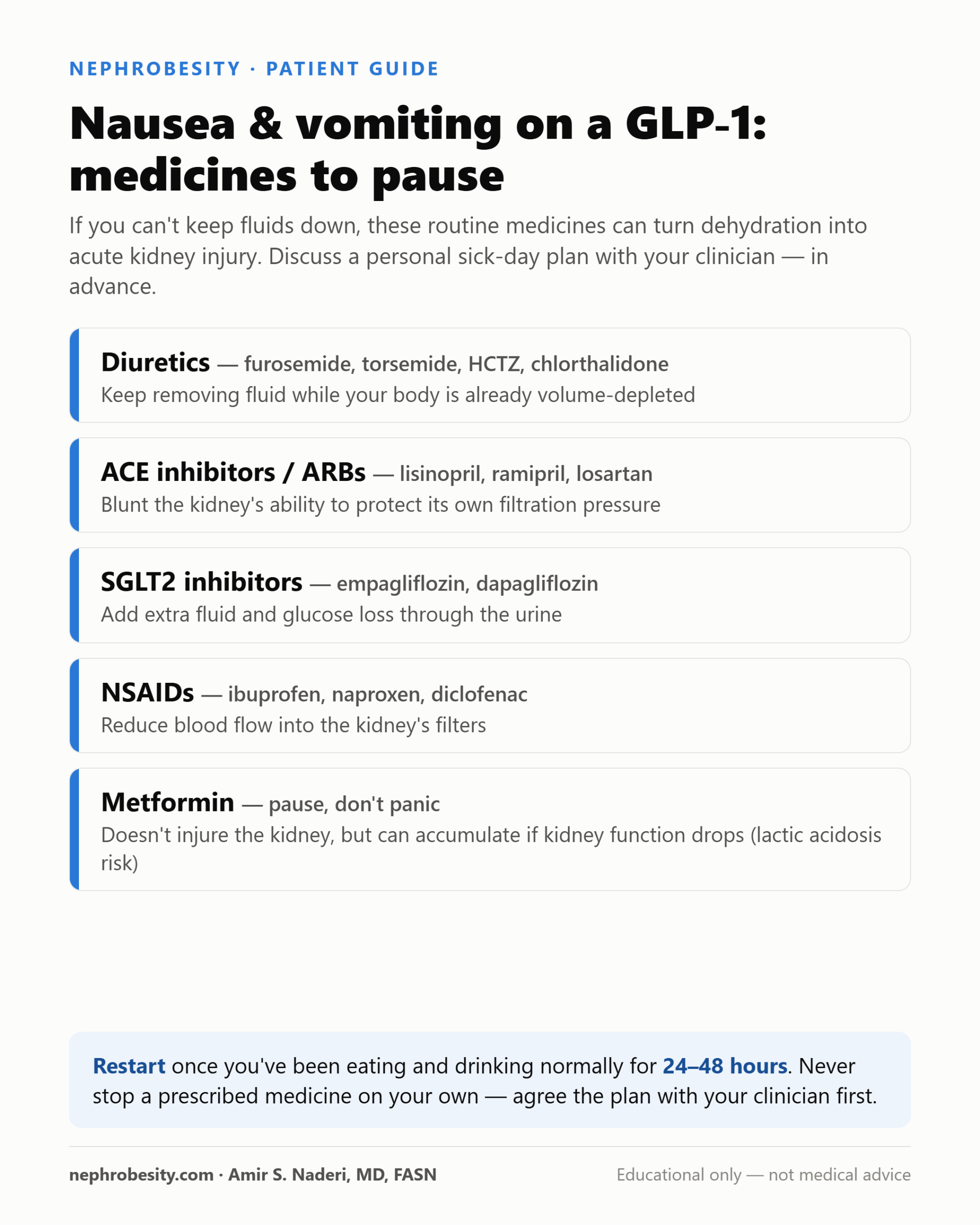
Nausea and vomiting on a GLP-1: which medicines to pause
Drug labels tie most GLP‑1–related kidney injury to dehydration from GI side effects. Several everyday medicines make it worse by removing the kidney’s ways of protecting itself when fluid is low:
| Medicine class | Common examples | Why it is risky while you are dehydrated |
|---|---|---|
| Diuretics (“water pills”) | furosemide, torsemide, hydrochlorothiazide, chlorthalidone | Keep pulling fluid out while you are already volume-depleted |
| ACE inhibitors / ARBs | lisinopril, ramipril, losartan, valsartan | Blunt the kidney’s pressure autoregulation |
| SGLT2 inhibitors | empagliflozin, dapagliflozin | Add extra fluid and glucose loss through the urine |
| NSAIDs | ibuprofen, naproxen, diclofenac | Cut blood flow into the kidney’s filters |
| Metformin | — | Does not injure the kidney, but can accumulate if kidney function drops (lactic acidosis risk) |
Whether you take semaglutide (Ozempic, Wegovy) or tirzepatide (Mounjaro, Zepbound), the same rule applies: it is these companion medicines — not the weekly injection itself — that your clinician may ask you to pause briefly during vomiting or severe diarrhea, and to restart once you have been eating and drinking normally for 24–48 hours. Never stop a prescribed medicine on your own without a plan you have agreed with your clinician.
What to do:
- Prevent it: increase the dose slowly, and eat smaller, plainer meals during titration.
- Hydrate on sick days: sip fluids or an oral rehydration solution (for example Pedialyte) steadily.
- Have a sick-day plan: ask in advance which of your medicines to hold when you are vomiting.
- Hold the GLP-1 itself: if you are actively vomiting or cannot keep fluids down, skip your next dose and do not increase the dose until symptoms settle — then confirm timing with your clinician.
- Get help for vomiting beyond ~24 hours, no urine output, dizziness, or confusion.
Bottom line. With nausea and vomiting on a GLP-1, the real kidney threat is not the nausea itself — it is dehydration. Keep fluids up, titrate slowly, and know which companion medicines to pause on a bad day — that combination prevents almost all of the kidney risk.
Full guides: Semaglutide (Ozempic/Wegovy) and Your Kidneys and Tirzepatide (Mounjaro/Zepbound) and Your Kidneys.
Related questions
Can vomiting on a GLP-1 hurt my kidneys? It can if it leads to dehydration. Fluid loss lowers blood flow to the kidney and can cause a temporary drop in function (acute kidney injury), which usually reverses with rehydration. The risk is higher if kidney function is already reduced or you take diuretics, ACE inhibitors/ARBs, SGLT2 inhibitors, or NSAIDs.
Which medicines should I hold when I am vomiting on a GLP-1? Often the diuretic (water pill), ACE inhibitor or ARB, SGLT2 inhibitor, and NSAIDs — but only on your clinician’s advice. The weekly GLP-1 injection itself is usually not the one you hold. Set up this sick-day plan in advance.
What should I drink if I feel nauseated on a GLP-1? Sip fluids steadily, and use an oral rehydration solution such as Pedialyte if you are losing fluid. Seek care if you cannot keep fluids down for more than about a day, stop urinating, or feel dizzy or confused.
References
- Watson KE, et al. Consensus recommendations for sick day medication guidance for people with diabetes, kidney, or cardiovascular disease. Am J Kidney Dis. 2023. Full text
- Perkovic V, et al. Effects of semaglutide on chronic kidney disease in patients with type 2 diabetes (FLOW trial). N Engl J Med. 2024;391:109–121. NEJM
- Ozempic (semaglutide) U.S. Prescribing Information, Section 5.6 “Acute Kidney Injury Due to Volume Depletion”. FDA label (PDF)
- NHS Think Kidneys. “Sick day” guidance in patients at risk of acute kidney injury. Guidance (PDF)
📬 Get two free guides + stay current. Join the newsletter and instantly get our two free PDF guides — Sick-Day Rules for Weight-Loss Injections and 5 Questions to Ask Before Starting a Weight-Loss Injection — plus a short monthly email when a new study actually changes how we think about weight-loss medication and your kidneys. No hype, no selling.
Written and medically reviewed by Dr. Amir S. Naderi, MD, FASN. Last updated: July 9, 2026. Educational information only — not medical advice. Never change or stop a prescribed medication without talking to your doctor.