Short answer: Usually no — GLP-1 drugs (Ozempic, Wegovy, Mounjaro, Zepbound) do not need to be held for a routine CT scan with iodinated contrast. The medicines that sometimes do need adjusting around contrast are metformin and SGLT2 inhibitors — not the GLP-1. The separate rule about holding a GLP-1 before a procedure applies to surgery and endoscopy under sedation (stomach-emptying/aspiration concern), not to lying still for a scan. Always tell the imaging team your full medicine list.
Do you need to stop a GLP-1 before a CT scan with contrast?
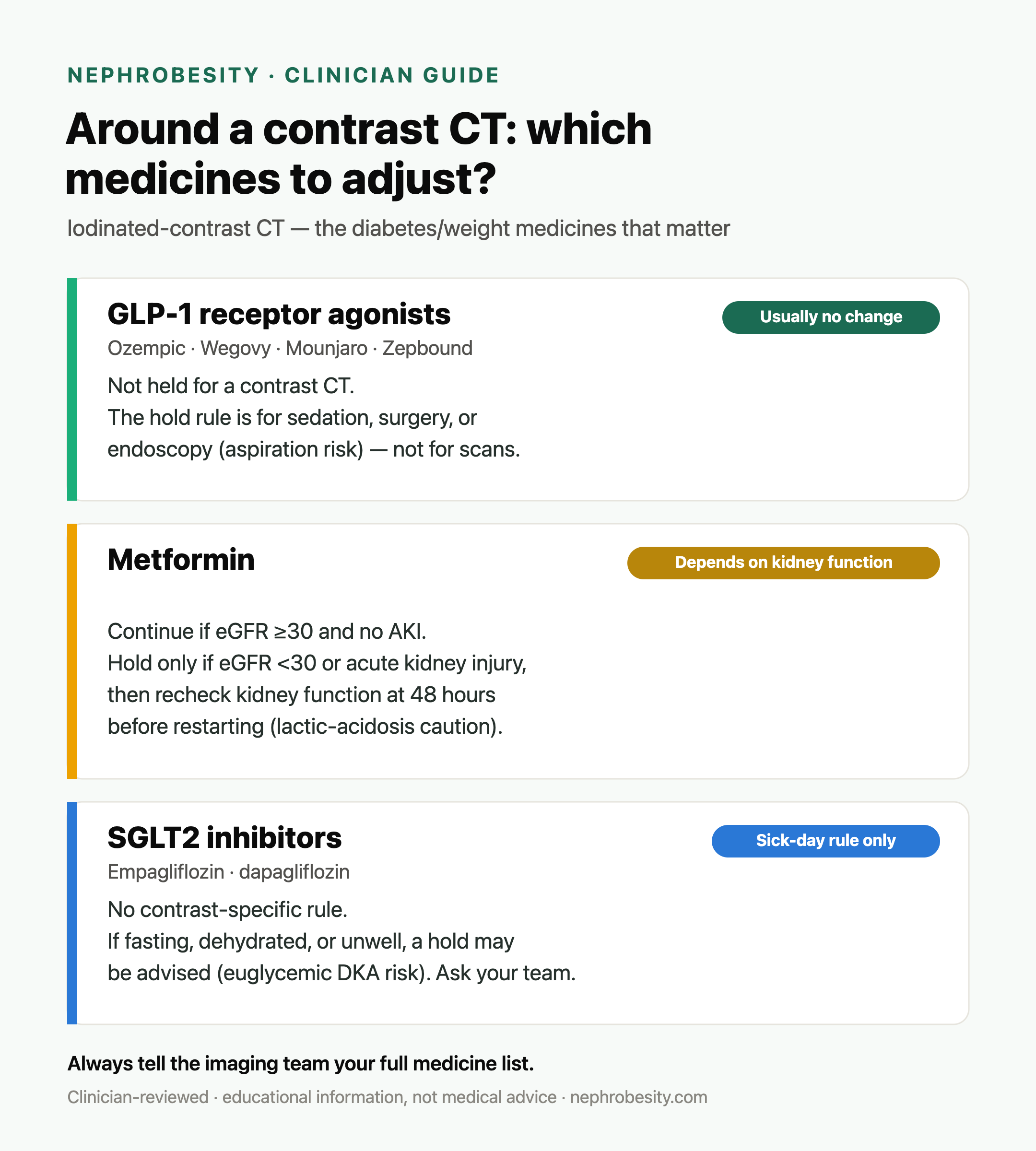
Why the GLP-1 usually doesn’t need a hold for contrast. The worry with contrast dye is mainly its effect on the kidneys, plus how certain diabetes drugs behave if kidney function dips. GLP-1 drugs are not cleared by the kidneys and don’t have a contrast interaction, so there’s no standard recommendation to stop them for a plain contrast CT.
The drugs that are affected by contrast:
- Metformin. Held based on kidney function. With normal function (eGFR ≥ 60) no hold is usually needed for IV contrast; with reduced function or other risk factors, it’s commonly held at the time of contrast and for 48 hours, then restarted after kidney function is rechecked. This is to avoid a rare acid build-up (lactic acidosis) if contrast temporarily strains the kidneys.
- SGLT2 inhibitors (empagliflozin, dapagliflozin). If the scan needs fasting, these are often held for a few days because fasting plus dehydration can trigger a serious problem called euglycemic ketoacidosis.
Where the GLP-1 hold really applies. Under 2024 multisociety guidance, holding a GLP-1 is discussed for surgery and endoscopy because slowed stomach emptying can raise aspiration risk under sedation/anesthesia — a different situation from a routine imaging scan.
What to do.
- Tell the imaging or pre-op team every medicine you take — GLP-1, metformin, SGLT2 inhibitor, diuretics, ACE inhibitors/ARBs, NSAIDs.
- Ask specifically about metformin and SGLT2 timing if you take them.
- Hydrate before and after contrast unless told otherwise — good for the kidneys.
- If the scan involves sedation or fasting, ask whether the GLP-1 should be paused for that reason.
Bottom line. For a standard contrast CT, your GLP-1 usually keeps going; it’s metformin and SGLT2 inhibitors that may need timing changes. Confirm with the team that orders the scan.
Related: Should I hold my diuretic when sick on a GLP-1? and Do I stop a GLP-1 before surgery?
Related questions
Does contrast dye interact with Ozempic or Mounjaro? No known interaction. Contrast’s main issue is kidney strain and how metformin/SGLT2 respond to it, not the GLP-1.
Do I hold metformin for a contrast CT? It depends on your kidney function. Normal function often needs no hold for IV contrast; reduced function usually means holding it for 48 hours with a kidney recheck. Your team decides.
Is contrast dye dangerous for my kidneys on these drugs? Contrast can transiently stress the kidneys in some people. Staying hydrated helps, and your team screens kidney function beforehand. The GLP-1 itself doesn’t add contrast-specific risk.
References
- American College of Radiology. ACR Manual on Contrast Media — metformin and iodinated contrast media. acr.org
- American Society of Anesthesiologists. Consensus-based guidance on preoperative management of patients on GLP-1 receptor agonists. 2023. asahq.org
- Multisociety clinical practice guidance for the safe use of GLP-1 receptor agonists in the perioperative period. Clin Gastroenterol Hepatol. 2024. cghjournal.org
- AGA Rapid Clinical Practice Update: management of patients taking GLP-1 receptor agonists prior to endoscopy. Clin Gastroenterol Hepatol. 2023. cghjournal.org
📬 Get two free guides + stay current. Join the newsletter and instantly get our two free PDF guides — Sick-Day Rules for Weight-Loss Injections and 5 Questions to Ask Before Starting a Weight-Loss Injection — plus a short monthly email when a new study actually changes how we think about weight-loss medication and your kidneys. No hype, no selling.
Written and medically reviewed by Dr. Amir S. Naderi, MD, FASN. Last updated: July 8, 2026. Educational information only — not medical advice. Never change or stop a prescribed medication without talking to your doctor.